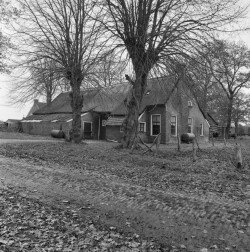
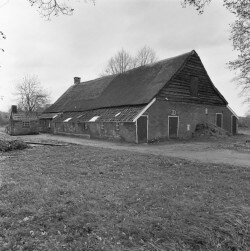
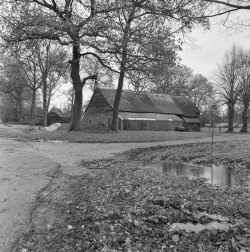
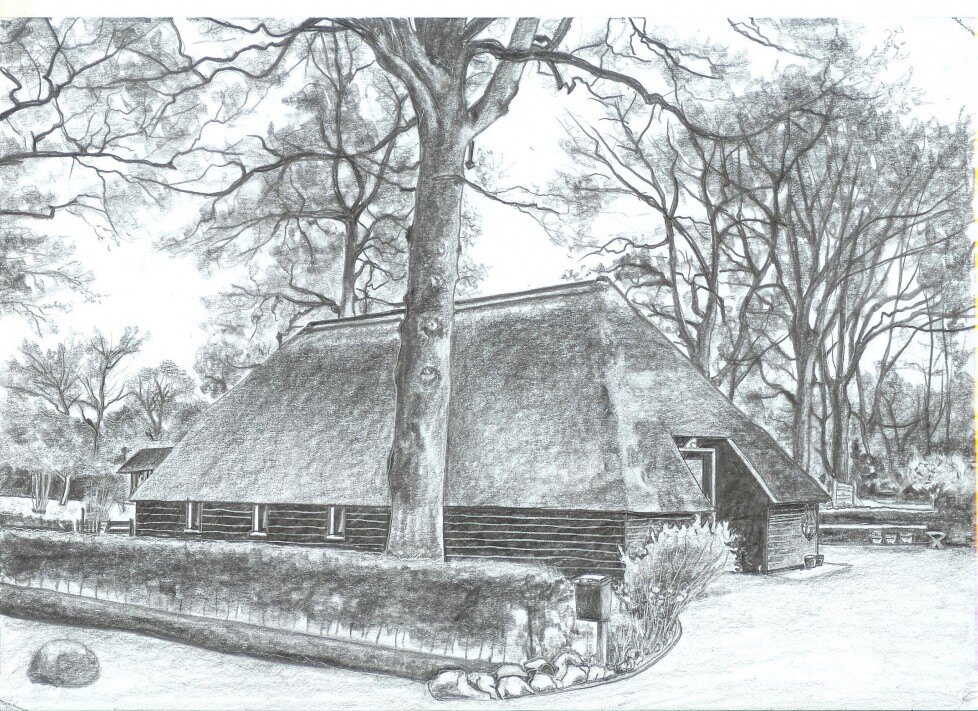
The Schepershoes has existed since 1612 and the first resident was 'the old shepherd' or the old sheep herder who cared for the sheep flocks around Peest. Between 1612 and 1807, the Schepershoes is inhabited by 16 different sheep herders about whom little is known.
In 1807, the house is inhabited by sheep herder Jan Brink and his 'market associates of Peest'. Jan Brink owned three cows and sixty sheep and was married to Antje Berends. Together they had seven children.
In 1832, the house is cadastrally known as section E no. 330, house and grounds of the Market Associates of Peest, covering 0.01.12 ha.
After payment of the head tax for the New Reformed Church, in 1836 Alberts Schans becomes the main resident of The Schepershoes. The then 51-year-old sheep herder is married to Roelfje Kruims and they have one child: Grietje. Two workers, Steven Wever and Jan Kruims, help keep the farm running.
From the village of Een, in 1840 sheep herder Gauke Bijma comes to The Schepershoes. He is married to Aaltje Kramer and they have four children.
Gouke Bijma leaves the farm around 1854 and then Jan Meulema settles as a sheep herder in The Schepershoes. Together with his wife Grietien ter Veld, they have two children. In the seventies, the family moves to another farm in Peest. The next sheep herder is Klaas Hofman, married to Trientien Scholte. They have a daughter named Grietje and presumably moved to Veenhuizen in 1879. The Schepershoes is then located on plot 3.
At the ground assessment of 1880, plot 3 is owned by Westerhof cs Marchien Boer (widow of Popke Westerhof). The plot still has the cadastral number E 330 and is 0.1.12 ha in size. According to the cadastral register, Wiebe de Boer, sheep herder in Peest, took over the house in 1878 from the market associates of Peest.
From the population register 1880/1890 it appears that Marchien Boer is the main resident of the house (Peest 145). Living with her are son-in-law Wijbe de Boer and daughter Marchien. They have two children. Between 1890 and 1900, the house is renumbered to Peest 15. Marchien Boer dies on 20 November 1900. Her granddaughter Annechien de Boer marries Wiebe Zorge and the couple remains living on plot 3 for now. (Grand)mother Marchien de Boer-Westerhof moves in May 1905 to plot 8, where she dies on 14 August 1907.
The new residents are Hendrik Baving, his wife Jantje Hofman and their daughter Derkien Baving. In 1906, their son Hendrik Jan Baving is born. The family moves on 22 April 1914 to Roden. From 21 May 1913, Wiebe Zorge jr. (son of Wiebe Zorge and Annechien de Boer of plot 8) lives with them and moves with the family to Roden. Annechien dies in childbed on 10 March 1913.
In 1914, Wiebe Zorge sr. returns as a farmer with his brother-in-law Popke de Boer and his son Jan Margienus Zorge to plot 3. On 15 May 1915, Wiebe jr. returns from Roden and departs on 17 January 1916 to Groningen. On 20 September 1918, Popke de Boer dies. He is unmarried. Wiebe Zorge sr. remarries on 15 June 1921 to Iemptje Kinds and together they have three children.
On 20 November 1936, Jan Margienus Zorge purchases the house and garden by auction, covering 30.12 are. In 1987, the house, barn and grounds - totaling 0.13.92 ha - are in the name of Zorge, Roelof.
After the death of Roelof Zorge, the house is sold to the Warmelink family. They restore the farmhouse under the supervision of the Heritage Service. The former sheep shelter is replaced by a new, much larger, brick barn.
In 2007, Het Schepershoes is sold to the current owners Alexander Sluijmer and Rinette de Jong. In the years that follow, they reinstall the barn doors and shutters at the windows. The barn and the heating shed also regain some of their former character through the addition of wooden cladding and old roof tiles. At the end of 2016, the thatched roof is replaced with a combination of thatch and tiles, just as it was before. This restoration took almost 8 weeks.
Source: Historische Vereniging Norch. Photos: Historische Vereniging Norch and Rijksdienst voor het Cultureel Erfgoed. Text: Irma Dorenstouter.